Soul, Sound, and Story: New Orleans Beyond the Beads
You know what? New Orleans isn’t just jazz and jambalaya—it’s alive with culture in every crack of its sidewalks. I wandered from gospel hums in Treme to street art that hits you right in the chest. This city breathes art. You’ll feel it in second-line parades, hidden galleries, and Creole kitchens. It’s raw, real, and wildly creative. If you think you know New Orleans, think again—this is the soul most tourists miss. Beyond the glittering beads and late-night revelry of Bourbon Street lies a deeper rhythm, one shaped by generations of resilience, creativity, and community. To truly understand this city, you must step off the beaten path and into neighborhoods where culture isn’t performed for visitors—it’s lived every day.
The Living Canvas: Public Art That Tells a Story
New Orleans is a city that speaks through its walls. Across neighborhoods like Bywater, the Seventh Ward, and Central City, murals rise not as decoration but as declarations. These are not the work of anonymous taggers or imported artists chasing trends. Instead, they emerge from local hands—painters, poets, and activists—who use color and composition to tell stories of survival, resistance, and rebirth. After Hurricane Katrina devastated the city in 2005, many communities turned to public art as a form of healing. Blank walls became canvases for collective memory, where grief, pride, and hope could be expressed in bold strokes and vivid hues.
One of the most powerful examples is the work of artist Brandan Odums, whose large-scale murals honor Black leaders, ancestors, and everyday heroes. His outdoor gallery, Studio BE, located in the historic Bywater district, once served as a warehouse but now stands as a monument to Black creativity and resilience. The name itself—BE—invites reflection: to be seen, to be heard, to be present. His pieces often feature portraits of figures like Malcolm X, Harriet Tubman, and local activists, rendered in striking contrast and symbolic color. These are not static images; they are calls to awareness, embedded in the very fabric of the community.
Walking through these neighborhoods feels like reading an open-air journal. A mural in the Seventh Ward might depict a grandmother cooking gumbo, surrounded by children learning recipes passed down through generations. Another in Treme shows brass band musicians mid-stride, their instruments raised as if the music is still playing. The art does not exist for tourists—it exists because the people need it. It marks territory, celebrates identity, and preserves history in a city where systemic neglect and gentrification threaten to erase long-standing communities. To see these works is not merely to observe; it is to witness a living archive, one painted not in silence but in full voice.
Jazz as Heritage, Not Just Entertainment
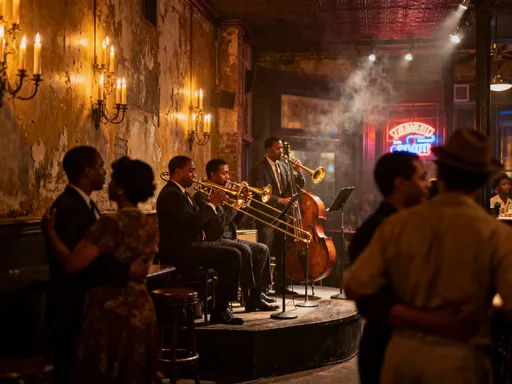
While many visitors flock to Frenchmen Street for jazz performances, the true heart of the music beats in neighborhood corners where the tradition is not performed but lived. Jazz in New Orleans is not a museum exhibit or a nightly show for tips—it is a lineage, a language passed from generation to generation. In Treme, often called the birthplace of jazz, music spills from porches, backyards, and corner bars with the ease of conversation. George’s Corner, a modest gathering spot, hosts Monday night jams where horns blare, drums roll, and the air thickens with improvisation. There is no stage, no cover charge, no spotlight—just neighbors, friends, and families coming together to keep the sound alive.
This tradition traces back to the early 1900s, when pioneers like Buddy Bolden and Jelly Roll Morton began blending African rhythms, brass band marches, and blues into something entirely new. The music was born out of community, shaped by the experiences of Black Americans in a segregated city. It was played at funerals as second-line processions, at church gatherings, and in dance halls where people found joy despite hardship. Today, that same spirit lives on in informal sessions where elders teach young musicians how to bend a note just right or how to listen before they play. Jazz here is not about technical perfection—it’s about feeling, about presence, about connection.
What makes these gatherings so powerful is the participation. People don’t just sit and watch; they dance in the street, clap in rhythm, call out to musicians by name. A child might pick up a tambourine and join in, guided by a nod from the drummer. A grandmother sways in her chair, eyes closed, as if transported. This is cultural continuity in its purest form—a living tradition that refuses to be commodified. When you attend one of these sessions, you’re not a spectator. You’re part of the rhythm, invited into a circle that has been turning for over a century.
Mardi Gras Indians: Threads of Resistance and Beauty
Among the most profound cultural expressions in New Orleans is the tradition of the Mardi Gras Indians. These are not performers in costumes; they are members of secret tribes who spend all year crafting elaborate suits adorned with feathers, beads, and intricate hand-sewn designs. Some suits weigh up to 150 pounds and can take thousands of hours to complete. Each piece is a masterpiece of artistry and symbolism, reflecting a fusion of African and Indigenous cultures. The tradition dates back to the 18th century, when escaped enslaved people found refuge in Native American communities. In honor of that alliance, Black New Orleanians created this unique celebration, blending West African masquerade traditions with Native American aesthetics.
On Mardi Gras morning, these tribes emerge in full regalia, parading through neighborhoods like Treme and the Seventh Ward. They do not perform for tourists or seek applause. Their chants, drumming, and dance steps are part of a sacred ritual, one rooted in resistance, identity, and spiritual protection. The silence between beats is as important as the music itself—a space for reflection, for honoring ancestors, for asserting presence in a city that has often tried to silence them. Outsiders rarely witness this fully, as access is guarded and respect is required. But if you are fortunate enough to see a tribe in full display, you will feel the weight of history in every step.
The designs on the suits are deeply personal and symbolic. Bead patterns may represent family lineages, spiritual beliefs, or social commentary. Feathers are chosen for their color and meaning, often reflecting the natural world or tribal identity. The process of making these suits is itself a communal act, with elders teaching younger members the techniques and stories behind each element. This is not fast fashion—it is slow, deliberate, and sacred. The Mardi Gras Indians remind us that culture is not something to be consumed; it is something to be carried, protected, and passed on.
The Kitchen as a Cultural Archive
In New Orleans, food is memory. Every dish tells a story of migration, survival, and love. Creole cuisine, in particular, is a living archive of West African, French, Spanish, and Caribbean influences, layered together over centuries. The roux in a pot of gumbo, slowly stirred until it reaches a deep chocolate brown, is more than a cooking technique—it is a symbol of patience, care, and continuity. Recipes are not written down; they are taught by hand, by smell, by taste. A grandmother might say, “Add the okra when the pot sings,” leaving the exact moment to intuition and experience.
Take the po’boy, a humble sandwich of fried shrimp or roast beef on French bread. It was born during the 1929 streetcar strike, when local sandwich shops gave free meals to “poor boys” protesting for fair wages. Today, it stands as a symbol of working-class pride and community solidarity. Places like Parkway Bakery & Tavern and Domilise’s have served them for generations, their walls lined with photos of regulars and historical moments. But the real magic happens in family kitchens and corner stores, where recipes are guarded like heirlooms.
Restaurants like Lil’ Dizzy’s Cafe in Treme offer more than meals—they offer stories. The smothered greens, red beans and rice, and fried chicken are served with a side of history. The owner might tell you how his grandfather cooked for musicians after late-night sets, or how his grandmother used to can tomatoes in the summer so nothing would go to waste. Cooking here is intergenerational, a way of keeping ancestors close. When a child learns to season gumbo just right—“a little salt, a little pepper, a little love”—they are not just learning to cook. They are learning to remember.
Hidden Stages: Where Culture Performs Off the Radar
Away from the neon lights and cover bands of Bourbon Street, New Orleans’ true cultural heartbeat can be found in unassuming places—church basements, neighborhood lounges, and backyard gatherings. The Candlelight Lounge in Central City is one such sanctuary. On Thursday nights, the blues come alive in a room dimly lit by flickering candles and string lights. Regulars pack the small space, knowing every lyric, every pause, every bend of the guitar. There is no stage, no soundcheck, no merchandise table. Just music—raw, honest, and deeply felt.
Similarly, St. Augustine Church hosts jazz masses that blend worship with improvisation. The choir doesn’t just sing hymns; they swing them, stretch them, let them breathe. The organ riffs like a saxophone, and the congregation claps in 4/4 time. These services are not performances—they are spiritual experiences, where faith and music become one. Visitors are welcome, but they are expected to listen, to participate with reverence, not to treat it as entertainment.
These spaces are not listed on tourist maps, and they do not advertise online. You find them through word of mouth, through respect, through showing up. They are not trying to be discovered; they are trying to survive. And yet, they thrive—because the people need them. They are places where culture is not extracted but nurtured, where art is not a product but a practice. To attend one of these gatherings is to understand that in New Orleans, culture is not something you watch. It is something you join.
Artists’ Neighborhoods: Bywater, Treme, and the Seventh Ward
Bywater, Treme, and the Seventh Ward are not trendy neighborhoods waiting to be discovered. They have been the cultural soul of New Orleans for generations. Treme, one of the oldest Black neighborhoods in the United States, is where brass bands were born, where jazz took root, where families have lived for over a century. Its streets echo with music, laughter, and the smell of slow-cooked greens. Backyard cookouts double as impromptu concerts, and stoops become stages for storytelling and song.
Bywater, with its pastel houses and iron gates, is home to painters, sculptors, and poets who work in sunlit studios tucked behind banana trees. The neighborhood has resisted the kind of commercial takeover seen elsewhere, in part because artists have bought and renovated homes, ensuring that creativity remains rooted in the community. The Seventh Ward, often overlooked, pulses with quiet strength. Its residents gather for second-line parades, support local businesses, and maintain traditions that outsiders rarely see.
Yet these neighborhoods face growing pressure from gentrification. Rising rents, property taxes, and short-term rentals threaten to displace long-time residents. But the community is fighting back—not with protests alone, but with ownership, art, and education. Black families are buying homes, artists are opening galleries, and elders are teaching youth the history of their streets. Living here is not a lifestyle choice; it is a commitment to preserving a legacy. These neighborhoods are not waiting for saviors. They are building their own future—one mural, one meal, one note at a time.
How to Experience Culture Like a Local (Without Overstepping)
To experience New Orleans’ culture deeply, you must come with humility. This is not a city to be consumed; it is a city to be respected. That means showing up early to neighborhood events, not just when the music starts, but when the setup begins. It means tipping musicians directly, not just taking videos to post online. It means asking before recording someone in prayer, in performance, or in grief. True cultural access is not about access at all—it’s about attitude.
Support Black-owned businesses and institutions. Visit Studio BE instead of generic art walks. Eat at Lil’ Dizzy’s, not just the famous tourist spots. Skip the voodoo tours—they often misrepresent and exploit spiritual traditions. Instead, take a history walk with a Treme resident who can share stories that aren’t in guidebooks. When you walk into a corner store, smile, say hello, say thank you. These small acts build trust, and trust opens doors.
Most importantly, listen more than you speak. Let the music wash over you. Let the stories settle in. Don’t try to explain it, package it, or sell it. Come curious, stay present, leave humbled. The culture of New Orleans is not yours to take. It is yours to witness, to honor, to protect. When you do, you become part of the rhythm, not just a visitor passing through.
The Pulse That Never Stops
New Orleans’ art and culture are not exhibits behind glass. They are not preserved for nostalgia or profit. They are lived, breathed, and made anew every day. They survive hurricanes, economic hardship, and the constant gaze of tourism because they are rooted in community, not commerce. They are sustained by people who cook, paint, play, and pray not for an audience, but for each other.
To experience this city fully is to move beyond the beads, beyond the bars, beyond the surface. It is to walk slowly, listen deeply, and engage with respect. It is to understand that culture is not something you find—it is something you join. It is made in the steam of a gumbo pot, in the silence between drumbeats, in the hands that sew a Mardi Gras suit, in the voices that sing jazz at midnight on a residential street.
Let New Orleans change you. Let it remind you that art is not separate from life—it is life itself. Let it teach you that heritage is not static; it is alive, evolving, resilient. And when you leave, carry that pulse with you. Not as a souvenir, but as a commitment—to listen, to honor, to create in your own way. Because culture, at its best, is not something we inherit. It is something we make, together, every single day.