You Won’t Believe Tashkent’s Hidden Architectural Gems
When I stepped into Tashkent, I expected Soviet-era blocks and dusty streets. Instead, I found a city where ancient Islamic design quietly breathes through modern facades. From turquoise-tiled mosques to avant-garde metro stations, Tashkent’s architecture is a layered story of resilience and reinvention. It’s not just about old buildings—it’s about how a city rebuilds its soul. This is architecture you can feel, not just see. Beneath the surface of broad boulevards and geometric parks lies a narrative of survival, identity, and quiet beauty. Tashkent, often overlooked in favor of Samarkand or Bukhara, holds a unique architectural soul shaped by seismic upheaval, political transformation, and cultural endurance. For travelers seeking depth over spectacle, this city offers an intimate dialogue between past and present.
First Impressions: The Contradiction of Tashkent
Arriving in Tashkent, the first view from the airport shuttle reveals a skyline defined by wide avenues, green spaces, and low-rise buildings with a distinct 20th-century rhythm. The city does not announce itself with grandeur. There are no towering minarets or sprawling citadels greeting visitors at the city limits. Instead, the initial impression is one of order—clean lines, tree-lined streets, and a surprising absence of urban chaos. This sense of calm is intentional, born from tragedy and reconstruction. The 1966 earthquake that devastated Tashkent, reducing much of the old city to rubble, became a turning point. In its aftermath, Soviet planners rebuilt with seismic resilience in mind, prioritizing functionality, open spaces, and standardized housing blocks.
Yet, within this modern framework, traces of older rhythms persist. The grid-like layout of central Tashkent, while utilitarian, preserves the orientation of former neighborhoods. Some street names still echo pre-Soviet history, and certain districts gently slope where ancient water channels once flowed. The city’s architectural identity emerged not from erasure but from layered adaptation. While the earthquake destroyed much of the historic fabric, it also created space for a new kind of urban expression—one that quietly reintegrated cultural motifs even under a secular regime. Today, walking through central Tashkent feels like reading a palimpsest: the Soviet chapter is visible, but the underlying script remains.
What surprises most visitors is the absence of architectural despair. Unlike other post-Soviet cities where decay dominates the landscape, Tashkent exudes care. Facades are maintained, public spaces are clean, and new developments reflect a growing civic pride. This is not a city frozen in transition but one steadily redefining itself. The blend of modern infrastructure and cultural sensitivity suggests a population invested in both progress and memory. For the observant traveler, the city’s contradictions—between old and new, local and imported, sacred and functional—become its most compelling feature.
The Soul in the Details: Islamic Motifs in Modern Buildings
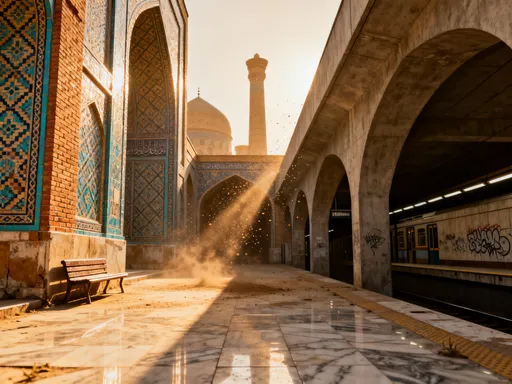
Beneath Tashkent’s orderly exterior lies a quiet renaissance of Islamic design. While the Soviet era suppressed religious expression, contemporary architects have found subtle ways to reintroduce traditional aesthetics into civic and private buildings. Geometric patterns inspired by centuries-old tilework now grace the facades of government offices, cultural centers, and even shopping complexes. These are not literal reconstructions but thoughtful reinterpretations—abstracted star-and-polygon motifs, stylized arabesques, and rhythmic banding that echo the visual language of Central Asian Islamic art.
One notable example is the design of the Uzbekistan State World Art Museum, where the exterior incorporates a modern take on muqarnas, the honeycomb-like vaulting common in medieval Islamic architecture. Though simplified, the effect is striking—light and shadow play across the surface, creating a sense of depth and movement. Similarly, the Alisher Navoi Academic Drama Theater features calligraphic elements integrated into its stone carvings, a nod to the region’s literary and spiritual heritage. These details do not shout; they whisper, inviting closer inspection.
Why do these elements matter? For a generation raised under state atheism, they represent a reconnection with cultural roots. They are not merely decorative but symbolic—acts of quiet reclamation. Architects today speak of a desire to create buildings that feel “of this place,” rather than generic international forms. This has led to a growing emphasis on context-sensitive design, where materials, proportions, and ornamentation reflect local traditions. In private developments, homeowners often incorporate traditional courtyard layouts or latticework windows, blending privacy with aesthetic continuity.
The revival is not without challenges. Some critics argue that modern interpretations risk becoming superficial—a kind of cultural pastiche. Yet, the most successful projects demonstrate deep research and respect for historical forms. The key lies in balance: honoring the past without replicating it, innovating without losing identity. In this delicate dance, Tashkent’s architecture becomes more than shelter—it becomes a statement of belonging.
Metro as Masterpiece: Underground Art You Can’t Miss
One of Tashkent’s most unexpected treasures lies beneath the surface: its metro system. Opened in 1977, the Tashkent Metro was the first in Central Asia and remains one of the most artistically rich subway networks in the world. Far from being a utilitarian transit system, it functions as an underground gallery of national pride, where every station tells a story through marble, mosaics, and light. For visitors, a metro ride is not just transportation—it is an immersive cultural experience.
Kosmonavtlar Station, dedicated to space exploration, exemplifies this blend of art and ideology. Its vaulted ceiling is adorned with celestial motifs and portraits of Soviet cosmonauts, rendered in shimmering mosaics. The walls, clad in white and blue marble, evoke the vastness of the cosmos. The lighting is carefully calibrated to enhance the ethereal effect, making passengers feel as though they are traveling through a starlit tunnel. Equally impressive is Tashkent Station, the central hub, where golden columns and intricate chandeliers create a sense of grandeur. The use of local materials—such as polished marble from Uzbek quarries—grounds the design in national identity.
Turkiston Station, named after the historic Turkic regions, features ornate arches and deep-blue tilework reminiscent of Samarkand’s Registan. The thematic coherence of each station transforms the metro into a narrative journey through Uzbek history and aspiration. Some stations honor poets, scientists, and national heroes, their designs reflecting the values they represent. The cumulative effect is powerful: a public space that elevates the everyday commute into something ceremonial.
For tourists, visiting the metro requires little planning but offers maximum reward. The best time to experience the stations is in the early morning or late afternoon, when lighting conditions highlight the mosaics and crowds are thinner. Visitors should move respectfully—no loud conversations or obstructing walkways—and avoid blocking commuters during rush hours. Navigation is straightforward, with clear signage in Uzbek and Russian, though English translations are limited. A simple map from the tourist information center or a local transit app can help identify key stations. Most importantly, take time to look up. The true artistry is in the ceilings, the columns, the details that reward slow, attentive observation.
Old City vs. New Districts: A Tale of Two Tashkents
Tashkent is not one city but many, layered over time. Nowhere is this more evident than in the contrast between the historic Hast-Imam district and the modern neighborhoods of Yunusabad or Mirobod. Hast-Imam, centered around the Barak Khan Madrasah and the Telyashayakh Mosque, preserves the intimate scale and organic layout of pre-earthquake Tashkent. Narrow alleys wind between low buildings with wooden balconies, and the air carries the scent of baked bread and incense. Courtyards open unexpectedly, revealing quiet spaces where elders sip tea and children play. The architecture here is human-scaled, with thick adobe walls, carved wooden doors, and tilework that glimmers in the sunlight.
In stark contrast, Yunusabad and similar districts showcase Tashkent’s 21st-century ambitions. Wide streets, high-rise apartments, and glass-fronted offices reflect a drive toward modernization. These areas prioritize efficiency and density, with buildings designed for maximum light and ventilation. While they lack the intimacy of the old city, they offer comfort, connectivity, and access to services. The architectural language here is international—clean lines, flat roofs, and large windows—but with subtle nods to local context, such as sun-shading screens inspired by traditional jali work.
How do residents navigate these two worlds? For many families, daily life bridges both. A grandmother may live in a courtyard house in Hast-Imam, while her daughter works in a high-rise office in the city center. Children attend schools in modern buildings but celebrate holidays in ancestral homes. This duality is not seen as a conflict but as a natural evolution. The old neighborhoods provide cultural continuity, while the new districts offer opportunity and convenience.
Urban planning in Tashkent reveals both successes and tensions. Preservation efforts in Hast-Imam have protected key landmarks, but gentrification pressures threaten the authenticity of daily life. In newer districts, green spaces are often sacrificed for development, leading to heat islands and reduced livability. The most effective urban design integrates lessons from both: the walkability and social fabric of the old city, combined with the efficiency and accessibility of the new. When done well, such integration creates neighborhoods that are not just functional but meaningful.
Soviet Legacy: Brutalism with a Heart
The Soviet-era housing blocks that dominate much of Tashkent are often dismissed as monotonous or bleak. Yet, a closer look reveals a different story—one of resilience, community, and quiet beauty. Built in the decades following the 1966 earthquake, these five- and nine-story apartment buildings were designed for speed, durability, and seismic safety. Their repetitive facades and utilitarian materials reflect the priorities of the time: shelter for the many, not architectural flourish for the few.
Yet, over time, these structures have been transformed by their inhabitants. Balconies overflow with potted plants, hand-knitted curtains filter the sunlight, and rooftop gardens bloom in summer. Communal courtyards host chess games, children’s swings, and impromptu gatherings. The symmetry of the buildings, once a symbol of state control, now frames a rich tapestry of private life. The scale, while imposing, fosters neighborly interaction—residents know each other, share resources, and maintain shared spaces with pride.
Architecturally, the Soviet legacy includes more than housing. Administrative buildings, cultural palaces, and educational institutions from the 1970s and 80s exhibit a restrained grandeur. The use of marble, bronze, and high ceilings in public interiors conveys a sense of civic dignity. Some structures, like the former Lenin Museum (now the State Museum of History of Uzbekistan), feature sculptural reliefs and monumental staircases that, while ideologically charged in their time, now serve as neutral backdrops for national memory.
Today, adaptive reuse is giving these buildings new life. Former administrative offices are being converted into co-working spaces, art studios, and community centers. The challenge lies in preserving structural integrity while updating infrastructure for modern needs. Insulation, plumbing, and energy efficiency are key concerns, but solutions are emerging. Some renovated buildings now feature solar panels, green roofs, and energy-efficient windows, proving that Soviet-era structures can meet 21st-century standards. The lesson is clear: even the most utilitarian architecture can gain soul through care and continuity.
Green Spaces and Urban Design: Parks That Shape the City
Tashkent’s reputation as a green city is well-earned. With over 300 parks and public gardens, it ranks among the most forested capitals in Central Asia. This emphasis on greenery is not accidental but deeply rooted in both tradition and necessity. In a region with hot summers, shade and cooling are essential. The city’s founders understood this, and today’s planners continue the legacy. Parks are not mere decorations but vital components of urban life, shaping how people move, gather, and relax.
Amir Timur Square, one of the city’s central green spaces, exemplifies this integration. Framed by government buildings and cultural institutions, the square features fountains, flowerbeds, and rows of poplar and plane trees. It is a place of formal beauty, often used for official ceremonies, but also a daily refuge for families, joggers, and elderly couples. The landscaping complements the surrounding architecture—symmetrical, orderly, and dignified—creating a harmonious public realm.
Alisher Navoi Park, named after the 15th-century poet, offers a different atmosphere. More intimate and shaded, it is a favorite among locals for weekend strolls, picnics, and informal music performances. Benches are strategically placed under trees, and small kiosks sell tea and snacks. Children play near fountains, and elders practice tai chi or chess. The park’s design encourages lingering, conversation, and connection. Nearby, the Navoi Opera and Ballet Theatre adds a cultural anchor, its neoclassical facade blending with the greenery.
These spaces do more than provide recreation—they shape social identity. In a city where private outdoor space is limited, parks become extensions of the home. They are democratic by design, accessible to all regardless of income. Urban planners increasingly recognize their role in improving air quality, reducing noise, and enhancing mental well-being. New developments now include green corridors and pocket parks, ensuring that nature remains woven into the city’s fabric. The balance between concrete and greenery is not just aesthetic—it is a measure of a city’s humanity.
Architectural Exploration Tips: How to See Tashkent Like a Local
To truly appreciate Tashkent’s architecture, one must move beyond the guidebook highlights. The city reveals its secrets slowly, to those who walk with intention. A recommended starting point is the walk from Amir Timur Square to Hast-Imam, a route that traverses Soviet modernism, Soviet monumentalism, and historic Islamic architecture. Begin early in the morning, when the light is soft and the streets are quiet. Notice how the facades change—the materials, the window proportions, the use of ornament.
For a deeper understanding, consider a guided walking tour with a local architect or historian. Several cultural organizations offer themed tours focusing on Soviet design, Islamic motifs, or urban planning. These tours provide context that self-guided exploration may miss, such as the symbolism behind a particular mosaic or the engineering innovations of the metro. While self-guided walks offer freedom, a knowledgeable guide can transform observation into insight.
Technology can also enhance the experience. The local transit app “Tashkent Metro” includes station histories and photo galleries, while mapping tools like Google Maps—used alongside offline city guides—help identify lesser-known buildings. Some architecture enthusiasts use augmented reality apps to overlay historical images onto present-day views, though this requires preparation. Carrying a small notebook to sketch details or jot down observations can deepen engagement.
Timing matters. Spring and autumn offer the most comfortable weather, with mild temperatures and blooming trees. Summer can be hot, but early mornings and shaded parks remain pleasant. Winter, while cold, provides a different perspective—snow on Soviet rooftops, frost on marble columns, and the quiet beauty of a city at rest. Regardless of season, wear comfortable shoes, carry water, and dress modestly out of respect for local norms. Engage with residents when appropriate; a simple greeting in Uzbek often opens doors to conversation.
The most important tip is to slow down. Tashkent’s architecture is not about spectacle but about presence. It rewards patience, attention, and curiosity. Look beyond the surface—examine a door handle, trace a pattern in the pavement, notice how light falls on a wall at different times of day. In these small details, the city’s soul becomes visible.
Tashkent’s architecture isn’t about grand monuments alone—it’s in the quiet details, the rebirth of tradition, and the courage to rebuild. It invites you to look deeper, walk slower, and appreciate how cities remember. For travelers seeking authenticity beyond the obvious, Tashkent offers a rare gift: a place where history doesn’t just stand still—it evolves.